
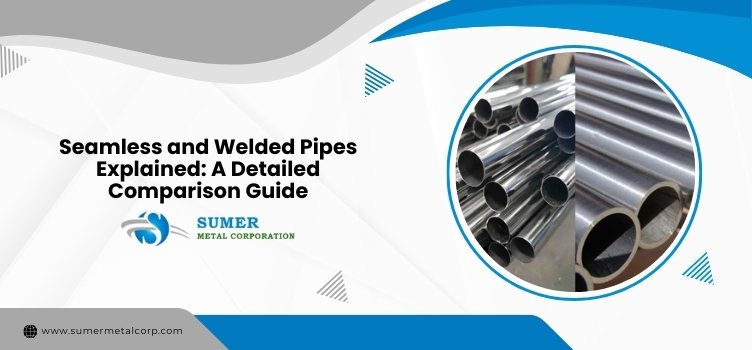
Understanding the Difference Between Seamless and Welded Pipes in Modern Construction
Concerning choosing the appropriate piping solution to be used in large-scale construction and infrastructure projects, it would be necessary to comprehend Seamless and Welded Pipes Explained: A Detailed Comparison Guide. Pipes are not mere channels and pathways through which fluids and gases move, but they are structural and functional elements of water that directly affect safety, efficiency and long-term viability. To the construction heads, architects, and contractors, the difference between seamless and welded pipes is usually the determinant of the performance of the project in terms of pressure, temperature fluctuations, and stress.
Both welded and seamless pipes are popular in various industries, which include construction, oil and gas, power plants and the water supply systems. Nevertheless, their production, power, price, and field of application vary in many ways. This seamless and welded pipes explained guide will make you have a clear picture of the differences between the two so that you can make well-informed decisions on high-value projects.
What Are Seamless Pipes and How Are They Manufactured?
Seamless pipes are manufactured without welding or seams. They are made by heating a solid, rounded billet, piercing it to make a hollow tube and rolling and sizing are done.
Key characteristics of seamless pipes include:
- Monolithic structure along the pipe length.
- None of the welded joints eliminates the possibility of weak points.
- Increased pressure and temperature strength.
Due to these characteristics, seamless pipes are widely applied in important applications where failure is not an option.
Advantages of Seamless Pipes in Industrial and Construction Projects
The knowledge of seamless pipe advantages is important in examining Seamless and Welded Pipes Explained: A Detailed Comparison Guide.
Major advantages include:
- Superior pressure-carrying capability.
- Improved performance in elevated temperatures.
- Increased anti-corrosion and mechanical strength.
These characteristics render seamless pipes to be applicable in power stations, refineries and high-rise constructions where long-term reliability is necessary.
What Are Welded Pipes and Why Are They Widely Used?
The welded pipes are produced by rolling steel plates or strips into a cylindrical shape, and the welding of the seam is required either longitudinally or spirally. The high-quality welding methods produce quality and strong joints.
Typical characteristics of the welded pipes:
- Visible or invisible welded seam.
- Available in large diameters.
- Cost-effective for large-scale usage.
Welded pipes offer a convenient compromise between performance and cost in a great number of construction uses.
Benefits of Welded Pipes in Infrastructure Development
The welded pipes are of great importance in the circumstances of Seamless and Welded pipes explained- a detailed comparison guide. because they are versatile.
Key benefits include:
- Lower manufacturing and procurement costs.
- Wide availability in different sizes and thicknesses.
- Faster manufacturer for bulk requirements.
Welded pipes are commonly used by contractors dealing with projects that are sensitive in terms of budgets.
Seamless and Welded Pipes Explained: A Detailed Comparison Guide
To have a better insight into the differences, we will compare seamless and welded pipes based on major parameters.
Strength and Pressure Handling
- Seamless pipes are stronger and should be used with high-pressure systems.
- Welded pipes can be used in the case of low and medium pressure.
Cost and Availability
- Continuous pipes tend to cost more because of the complicated production.
- Welded pipes are cost-effective, and they are readily supplied in bulk.
Size Range
- Pipes with a seam are restricted to a large diameter.
- Welded pipes may be produced with a very large diameter.
Application Suitability
- Critical systems such as boilers and heat exchangers have seamless pipes.
- Pipelines: Structural pipelines, water pipelines, and gas pipelines are made with welded pipes.
It is such a comparison that makes it clear why it is best to know the requirements of an application and why it is not just a matter of selecting one type of application over the other.
How to Choose Between Seamless and Welded Pipes for Your Project?
To the construction heads and architects, the choice of the correct pipe is reliant on the technical and operational considerations.
Consider the following before making a decision:
- Pressure of operation and temperature.
- Corrosion risk and environmental exposure.
- Financial limitations and the size of the project.
- Standards, regulatory and safety.
A critical analysis based on the knowledge gained during Seamless and Welded Pipes Explained: A Detailed Comparison Guide can guarantee the best choice of materials and the success of the project over a long period of time.
Applications of Seamless and Welded Pipes in the Construction Industry
The two types of pipes are used differently in contemporary constructions.
Seamless pipe applications
- High-rise building services
- Power generation plants
- Industrial process piping
Welded pipe applications
- Structural frameworks.
- Water distribution systems.
- Transportation pipelines of gas and oil.
The knowledge of such applications can guide contractors to match structures and operational requirements with the selection of pipes.
Conclusion
To sum up, Seamless and Welded Pipes Explained: A Detailed Comparison Guide demonstrates that both types of pipes possess their advantages and the situations when each of them should be applied. Seamless pipes are stronger, more resistant to pressure and perform in harsh environments, whereas welded pipes are economical, can be used in any size and are more readily available. Based on the analysis of project requirements, working conditions, and budget factors, construction professionals will be aware of the appropriate solution for piping to establish a durable and effective infrastructure.
FAQs
Q1. Which is better: seamless or welded pipes for high-pressure applications?
The smooth pipes are more applicable in high-pressure situations since they are uniform in structure and do not have any welded joints. Get to know the pressure-rated piping standards more to make sure that your project is going to comply.
Q2. Are welded pipes safe for construction and infrastructure projects?
Yes, welded pipes are safe, and they are used extensively in construction, provided that they are produced and tested as per industry standards. See building codes and specifications on materials and ensure.
Q3. Why are welded pipes more economical than seamless pipes?
Compared to the other types, welded pipes require fewer manufacturing procedures and raw materials and are therefore cheaper when it involves large-scale projects. Discover infrastructure material cost-optimization techniques to make better budgets.
Ready to make the right material choice for your next project? Use this Seamless and Welded Pipes Explained: A Detailed Comparison Guide to evaluate your requirements and consult with a trusted piping supplier today. For expert guidance and product inquiries, contact us or email us sales@sumermetalcorp.com to discuss the best piping solutions for your construction and infrastructure needs.