
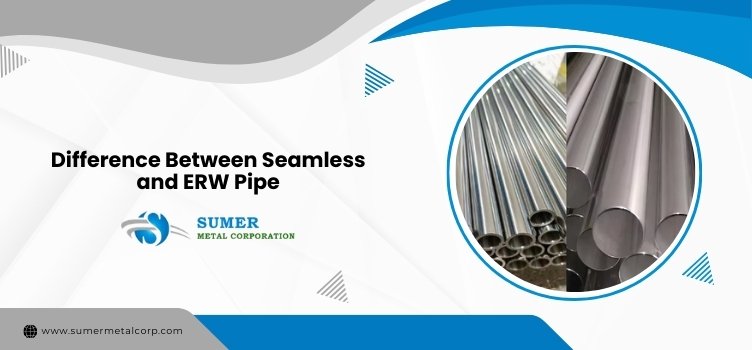
Understanding Pipe Selection for Strength, Safety, and Long-Term Performance
In the comparison between Seamless and ERW pipe, the difference is mostly determined by the manufacturing process, mechanical strength, cost and applicability. This difference can be understood to enable the decision-makers to avoid overengineering, lessen failures, and optimize budgets without impairing safety. This paper describes the Difference Between Seamless and ERW Pipe in a simple, practical manner that allows project leaders in large-scale projects to make sure that they pick the appropriate type of pipe.
Selection of the correct type of pipe is a very important choice to make during construction, infrastructure, and industrial work. Seamless vs ERW pipe is one such topic that is highly common and misjudged by the construction heads, architects and contractors. Pipes are not merely conduits of fluids or gases, but they have a direct impact on the structural safety, the pressure handling, corrosion resistance, and the general durability of a project.
Seamless vs ERW Pipe Manufacturing Process
The shape of the pipe is also one of the critical elements of the Seamless vs ERW pipe manufacturing process.
Seamless Pipe Manufacturing Process
Around a billet is made up of solid round, which is straightened into seamless pipes. The billet is heated and poked to create a hollow tube, and this is rolled and stretched to obtain the necessary diameter and thickness.
Key characteristics:
- No welded joint or seam
- Evenly distributed strength in the pipe.
- Increased high-pressure resistance.
This process renders smooth pipes suitable for use in situations that require no failure.
ERW Pipe Manufacturing Process
(Electric Resistance Welded) ERW pipes are produced by rolling coils of steel into a cylindrical shape and continuously welding the seam longitudinally by applying electric resistance welding.
Key characteristics:
- Heavy or light welded seam.
- Consistent dimensions.
- Cost-effective production.
This is the essential difference in the working of the process, which makes the ERW vs Seamless pipe comparison based on performance and price.
Seamless vs ERW Pipe: Strength and Pressure Handling
The factor that will determine the difference between the Seamless and the ERW pipes is strength.
Seamless pipes:
- Provide greater tensile capability.
- Do not operate well under pressure.
- Appropriate in harsh temperature and stress conditions.
ERW pipes:
- Sufficiently low to medium pressure strength.
- Modern manufacturing has a better quality of welding.
- Stable in the case of normal building construction.
In the case of high-rise buildings, refineries and power plants, seamless pipes are commonly used because they can be safely used in carrying loads and pressure that varies.
Seamless Pipe vs ERW Pipe: Difference in Applications
The Seamless pipe vs ERW pipe difference requires one to understand the suitability of the application.
Common Applications of Seamless Pipes:
- Oil and gas transmission
- Boilers and heat exchangers
- Hydraulic systems of high pressure.
- Power generation plants
Common Applications of ERW Pipes:
- Water pipelines.
- Scaffolding and structural columns.
- Large-volume intravenous transport.
- Construction and interior decoration projects.
ERW pipes are commonly used by architects and contractors in structural frameworks, whereas seamless pipes are most commonly used in energy and process industries.
ERW vs Seamless Pipe Comparison: Cost and Availability
The economy is also a significant factor in large-scale construction planning.
ERW pipes:
- Lower manufacturing cost.
- Stocked in abundance over the counter.
- Faster delivery timelines
Seamless pipes:
- Increased price because of the complicated manufacturer.
- Individual size is not as large as ERW.
- More favored when performance is more important than budget.
When comparing ERW vs Seamless pipes, ERW pipes would be best suited in a project where normal performance is compliant with the regulatory requirements without the unjustified cost.
Corrosion Resistance and Surface Finish
Surface finish and behavior on corrosion are other distinctions between Seamless and ERW pipe.
- Even the pipes used seamlessly tend to be more uniform, which limits weak points.
- ERW piping can be inspected further at the weld point.
- Respectable coating and grade of material are valuable to both types.
To be long-term, proper material choice and protective measures are of more significance than the type of pipe in itself.
Conclusion
To sum up, Seamless and ERW pipe have a distinction in the way they are made, their strength, cost and their applicability. Seamless pipes are superior in high-pressure, high-temperature, and critical conditions, whereas ERW pipes have a cost-effective and reliable solution in structural and low-pressure conditions. Knowledge of the Seamless vs ERW pipe will help construction heads, architects, and contractors make informed choices that will ensure safety, performance and cost efficiency.
FAQs
Q1. What is the main difference between Seamless and ERW pipe?
The main distinction is that manufacturing seamless pipes does not contain a seam that was welded, whereas the ERW pipes are constructed by welding steel coils, which affects strength and pressure handling.
Q2. Which is better: Seamless vs ERW pipe for construction projects?
ERW pipes tend to be adequate and affordable to use in a typical construction and structural application. Smooth pipes are superior in high-pressure or other critical use.
Q3. How does the Seamless vs ERW pipe manufacturing process affect performance?
The smooth process offers homogeneous strength along the pipe, whereas ERW pipes use weld strength, and thus seamless pipes are stronger when the conditions are extreme.
Planning your next project and need expert guidance on the difference between Seamless and ERW pipe? Contact our team today to select the right pipe solution that ensures safety, durability, and long-term value for your construction or infrastructure project.